Day 5 · Hearing a Dead Language
No one has heard Chaucer’s English spoken, and no one has heard Coptic spoken in centuries. Yet we can say a surprising amount about how both sounded. Today we work out how, starting from a poem and ending at a measurement.
How do we know Chaucer rhymed?
Yesterday’s text already left clues. Chaucer writes in couplets, in a steady ten-beat line, but the rhythm only works if you pronounce things we have since dropped. The opening keeps its beat only when you sound the final -e in soote (say it SOH-tuh) and give Aprille its full three syllables. The meter records a pronunciation we no longer use.
Rhyme records more. Some of Chaucer’s rhymes no longer rhyme for us, because the vowels of English shifted in the centuries after him, in the change called the Great Vowel Shift. Where a rhyme has broken on the page, it tells us the two words once sounded alike, and roughly how.
So the text carries evidence about its own sound. To use that evidence, though, we need a way to talk about sound precisely. That’s what phonetics gives us.
Discussion questions
The meter only works if the silent -e wasn’t silent. Is that a discovery about the language, or just a convenient assumption that makes the lines scan?
If two of Chaucer’s words rhyme on the page but not in your mouth, which one changed: the spelling, or the sound?
We will never have a recording of Chaucer. What would even count as evidence that a reconstruction of his pronunciation is right?
A crash course in phonetics
Phonetics is the study of speech sounds as physical events: how the body makes them, and what they look like as sound. None of it needs prior training. You already do all of it every time you talk. What follows names the parts and the categories, so that when we start measuring we have words for what we are measuring.
Speech is waves in air
Every speech sound starts as a column of air leaving the lungs. On its way out it passes through three stations, and each station does something to it.
First the lungs push the air up. They are the power supply. On their own they make no sound, only a stream.
Then the air reaches the larynx, the box of cartilage you can feel as your “Adam’s apple.” Stretched across it are the vocal folds (older books say “vocal cords”), two flaps of tissue. They can do two things. Held apart, they let the air pass silently, as during the s of bus. Drawn together and set vibrating by the airstream, they buzz, opening and closing hundreds of times a second. This is voicing, the raw sound behind every vowel and behind consonants like z. The rate of that buzz is the pitch of the voice: faster buzz, higher pitch.
Above the larynx is the supralaryngeal vocal tract, everything from the larynx up to the lips and nostrils. This is the chamber that shapes the buzz into recognizable sounds. The parts that do the shaping are the articulators:
the lips
the teeth
the alveolar ridge, the bony shelf just behind the upper teeth (run your tongue tip up from your teeth and you feel it)
the hard palate, the dome at the roof of the mouth
the soft palate or velum, the soft tissue further back
the uvula, the small flap hanging at the very back
the tongue, which we divide into tip, body, and root, because different parts of it act independently
the glottis, the space between the vocal folds themselves.
Some articulators move (the tongue, the lips, the velum). Others are fixed targets the movers reach toward (the teeth, the alveolar ridge, the hard palate). A speech sound is largely a description of which mover went to which target, and what it did there.
Consonants: three parameters
A consonant obstructs the airstream somewhere in the tract. We describe each one with three facts: where the obstruction is (place), how the air gets past it (manner), and whether the vocal folds are buzzing (voicing). Give those three and you have named the consonant.
Place of articulation is where in the tract the action happens. Working front to back:
bilabial: both lips, as in p, b, m (pat, bat, mat)
labiodental: lower lip against upper teeth, as in f, v (fan, van)
dental: tongue at the teeth, as in the two th sounds (thin, then)
alveolar: tongue at the ridge behind the teeth, as in t, d, s, z, n, l (tip, dip, sip, zip, nip, lip)
postalveolar: just behind that ridge, as in sh and the middle of vision (ship, measure)
palatal: tongue body at the hard palate, as in y (yes)
velar: tongue body at the soft palate, as in k, g, and ng (kit, get, sing)
uvular: back of the tongue at the uvula. English has none, but it is the French r in rouge and the Arabic q
pharyngeal: a constriction in the throat itself. English has none, but Arabic does
glottal: at the vocal folds, as in h (hat) and the catch in the middle of uh-oh.
Manner of articulation is how completely, and in what way, the air is obstructed:
plosive (or stop): the tract is sealed, pressure builds, then releases in a little burst: p, b, t, d, k, g (pat, get)
nasal: the mouth is sealed but the velum drops so air escapes through the nose: m, n, ng (mat, nap, sing). Pinch your nose and try to say “mmm”. It dies, because the only exit is blocked
fricative: the tract is narrowed but not sealed, so the air hisses through: f, v, s, z, sh, th, h (fan, sip, ship)
affricate: a stop released into a fricative, as one sound: the ch of church and the j of judge
trill: an articulator flutters in the airstream: the rolled Spanish or Italian r
tap or flap: a single quick contact: the American t in butter, which is really a flap
approximant: the tract narrows but not enough to make noise: w, y, r (wet, yet, red)
lateral: air flows around the sides of the tongue: l (let).
Voicing is the third parameter, and it is the simplest to feel. Put a finger on your throat, against the larynx, and hold a long “sssss.” Now switch to “zzzzz” without stopping. You feel the buzz switch on. s and z are made in exactly the same place, in exactly the same manner. The only difference is that the vocal folds are vibrating for z and still for s. The same pairing runs all through English: p/b, t/d, k/g, f/v are each a voiceless sound and its voiced twin. Vowels are all voiced.
Almost every sound here is made on air pushed out of the lungs. These are pulmonic sounds, and they are nearly all you need for English or Coptic or Arabic. A few languages also use non-pulmonic sounds made with other airstreams (the clicks of southern African languages, for instance), but we can set those aside.
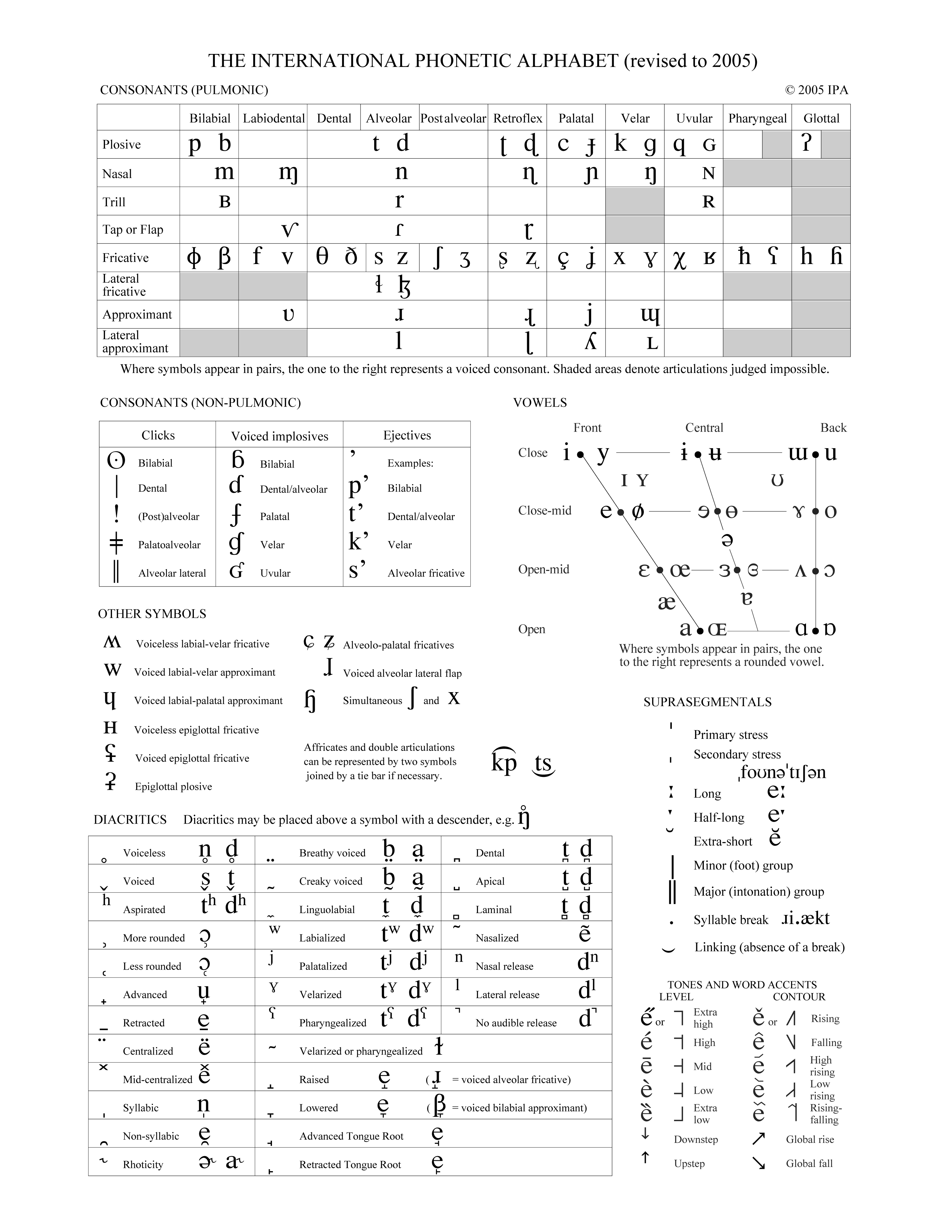
Figure 1:The IPA chart, from the International Phonetic Association.
The physicality of speech
Let’s look together at what the speech organs are actually doing to produce these sounds.
Discussion questions
Say “buzz” and “bus” with a finger on your throat. What is the one parameter that differs between z and s: place, manner, or voicing?
Pinch your nose and try to say m, n, and ng. Why do they fail, when b, d, and g do not?
p and b are the same place and manner, differing only in voicing. Find two more such pairs in English and say which member is voiced.
The chart has slots for uvular and pharyngeal sounds that English never fills. Why would a phonetic alphabet keep symbols for sounds the describer’s own language lacks?
Vowels in depth
A vowel is the opposite of a consonant: the tract is open, the air flows freely, and what changes from one vowel to the next is the shape of the open tube, mostly where the tongue body sits and what the lips do. Because nothing actually touches, you can’t describe a vowel by “place” and “manner.” Instead phoneticians use a small set of continuous dimensions.
Height is how high the tongue body rides in the mouth. Say beet, then bat, slowly, and feel your jaw and tongue drop. beet is a close (or high) vowel, while bat is an open (or low) vowel. Between them are intermediate steps: close-mid (the vowel of bait) and open-mid (the vowel of bet).
Backness is how far forward or back the tongue body sits. Say beet, then boot. The tongue pulls back for boot. beet is a front vowel, boot is a back vowel, and the vowel in the middle of sofa (the relaxed “uh” called schwa) sits in the central middle.
Rounding is what the lips do. Say boot and watch a mirror or feel your lips: they purse into a circle. Now say beet: they spread. boot is rounded, beet is unrounded. In English the back vowels happen to be rounded and the front ones not, but the two are independent. French tu is a front vowel said with rounded lips, which is why it is hard for English speakers.
Phoneticians arrange these on the vowel quadrilateral, a four-sided figure that stands for the space inside the mouth: front at the left, back at the right, high at the top, low at the bottom. Each vowel is a point in it. To anchor the chart against something universal rather than one language’s vowels, phoneticians defined a set of cardinal vowels: reference points at the extreme corners and edges of the possible space, like the cardinal directions on a compass. Any real vowel can then be placed relative to those fixed points.
One more distinction English leans on heavily: tense versus lax. The vowel of beet is tense. The vowel of bit is lax: shorter, slightly lower and more central, the tongue less strained. beet/bit, bait/bet, boot/book are tense/lax pairs. The difference is easy to hear and surprisingly hard to draw, which is part of why English vowels resist tidy spelling.
Discussion questions
Say beet, bait, bet, bat slowly in a row. Which dimension is changing, and in which direction?
Say beet then boot. Two things change at once: backness and rounding. Try to change only one: round your lips while saying beet. What comes out?
Schwa (the “uh” in sofa) is the most common vowel in English and the one we reach for when a vowel is unstressed. Why might a relaxed, central vowel be the natural “rest position”?
English spelling gives beet and bit two different vowels but no consistent way to tell which is which (meet/met, bite/bit). What does that tell you about using spelling as evidence for pronunciation?
Beyond single sounds: suprasegmentals
So far we have described sounds one at a time, the segments. But speech also carries information riding across segments, in properties of whole syllables and phrases. These are the suprasegmentals, and they matter for reading old verse.
Stress is the prominence of one syllable over its neighbors: louder, longer, higher. English uses it to distinguish words: RECord the noun versus recORD the verb, PERmit versus perMIT. It is also what meter is built from: Chaucer’s line is a pattern of stressed and unstressed syllables, and a line scans only when the stresses fall where the pattern wants them.
Vowel length is how long a vowel is held. In some languages a long vowel and a short vowel are different sounds entirely. Chaucer’s “long” vowels were genuinely longer, and the Great Vowel Shift is a story about what happened to them.
Tone is the use of pitch to distinguish words: in Mandarin, the syllable ma means different things on a high, rising, dipping, or falling pitch. English has no lexical tone, but it has intonation, the rise and fall of pitch across a phrase that marks a question, a statement, or surprise. “You’re leaving.” and “You’re leaving?” differ only in intonation.
Syllable structure is how sounds group into syllables, each built around a vowel (the nucleus) with optional consonants before (the onset) and after (the coda). strengths is one English syllable with a heavy onset and coda, while a is one with neither. How many syllables a word has, and where they fall, is exactly what meter counts, which is why giving Aprille its full three syllables matters.
Discussion questions
Say PERmit (the noun) and perMIT (the verb). Nothing about the consonants and vowels changed. What did?
Meter counts syllables and their stress. Which suprasegmentals does a poem’s rhythm depend on, and which does it ignore?
English has intonation but not tone. Mandarin has both. What might a writing system that never marks pitch fail to record about a poem read aloud?
Phonology: which differences count
Phonetics describes the sounds the mouth can make. Phonology asks which of those differences a particular language actually uses to tell words apart. The two are different questions, and the gap between them is where a lot of the subtlety lives.
A phoneme is a sound difference that changes meaning in a given language. In English, /p/ and /b/ are separate phonemes, because pat and bat are different words. We show that with a minimal pair: two words that differ in exactly one sound and mean different things. pat/bat, sip/zip, beet/bit: each pair proves its two sounds are distinct phonemes in English.
But a single phoneme is pronounced differently in different places, and English speakers don’t notice. The /p/ of pin comes with a puff of air (hold a hand to your mouth and feel it). The /p/ of spin does not. These two actual sounds are allophones: physically different realizations of the same phoneme. We never hear them as different because no English word is distinguished by the puff. The difference is automatic, governed by where the sound sits. When two sounds never appear in the same context (aspirated p only at the start of a stressed syllable, plain p only after s) they are in complementary distribution, a sure sign they are allophones of one phoneme rather than two phonemes.
Phonemes are written in slashes, /p/. Specific sounds in brackets, [pʰ] for the aspirated one. So the English phoneme /p/ has allophones [pʰ] and [p]. The same physical sound can be a phoneme in one language and a mere allophone in another. Aspiration is contrastive in Hindi, where it makes minimal pairs.
Two more facts about sounds in sequence, because they bear on reading scribes:
Coarticulation is the way neighboring sounds bleed into each other. You don’t say a word as a string of separate sounds. The tongue is already moving toward the next target while finishing the last. The /k/ of key is made further forward than the /k/ of cool, pulled there by the front vowel that follows. Speech is continuous, not discrete.
Assimilation is coarticulation gone far enough to change the category. in- plus possible becomes impossible: the /n/ turns into /m/ to match the following lip sound. English handbag is usually said “hambag.” When a scribe writes what assimilation produced rather than the “underlying” form, that spelling is evidence about how the word was actually said.
Discussion questions
Find a minimal pair that proves /l/ and /r/ are separate phonemes in English. Why might a speaker of a language without that contrast struggle to hear it?
Hold your hand to your mouth and say pin, then spin. The two /p/ sounds differ physically. Why has it probably never occurred to you that they’re different?
If a scribe spells handbag as hambag, has he made an error, or recorded something true?
The same physical difference (puff or no puff) is a phoneme in Hindi and an unnoticed allophone in English. What does that say about whether sound differences are “real”?
Vowels as two numbers
Now we can connect the open shape of a vowel to a number we can measure off a recording. The link is the source–filter theory, and it is exactly what the notebook’s synthesizer acts out.
A voiced sound has two parts. The source is the buzz from the vocal folds, a raw, pitched rasp, the same for every vowel. The filter is the tube of the vocal tract above the larynx, and its shape decides which frequencies in that buzz get amplified and which get damped. Change the shape of the tube, move the tongue, round the lips, and you change which frequencies ring. A vowel is one buzz played through differently shaped tubes.
Every tube has resonances, frequencies at which it rings strongly, the way a bottle has a pitch when you blow across it. The vocal tract’s resonances are called formants, and they show up as peaks of energy in the sound. The vowel you hear is set almost entirely by where the lowest formants sit. Crucially, the formants depend on the shape of the tract, not on the pitch of the buzz: you can say ah high or low and it stays ah, because moving the pitch moves the source without moving the filter. Pitch and vowel are independent, and the notebook shows this directly.
The two lowest formants are enough to tell most vowels apart, and they line up with two of the dimensions we just learned:
the first formant, F1, tracks tongue height, but inversely. A high (close) tongue gives a low F1. A low (open) tongue gives a high F1. beet (high tongue) has a low F1, while bat (low tongue) has a high F1.
the second formant, F2, tracks backness. A front tongue gives a high F2. A back tongue gives a low F2. beet (front) has a high F2, while boot (back) has a low F2.
So each vowel becomes a pair of numbers, (F1, F2). Plot F1 against F2 and every vowel is a point. A speaker’s whole set of vowels forms a cloud called the vowel space. If you flip both axes, so high F1 points down and high F2 points left, the cloud comes out in the same arrangement as the vowel quadrilateral drawn from the mouth. We will have reconstructed the chart of tongue positions from sound alone, without ever looking inside a mouth.
Different speakers and dialects shift and stretch the cloud, and that is exactly what makes it useful: the shape and placement of someone’s vowel space is a fingerprint of how they speak. The notebook synthesizes vowels with chosen formants, listens to them, measures the formants back, and draws the space.
Discussion questions
F1 tracks tongue height but runs backwards: a high tongue gives a low F1. Why might “higher tongue, lower number” be confusing, and does it matter once you’ve drawn the chart?
A vowel stays the same vowel whether you say it high or low in pitch. In source–filter terms, what stayed fixed and what moved?
If two speakers say “the same vowel” but get different formant numbers, in what sense is it the same vowel? (Hold this question. Section 8 of the notebook answers it.)
F1 and F2 capture which vowel you said. What about a vowel, or about a voice, do those two numbers leave out entirely?
The Great Vowel Shift
Now we can say precisely what changed between Chaucer and us, because the change was a movement through exactly this space. Over roughly 1400–1700 the long vowels of English all shifted, and they shifted in a chain.
Chaucer’s long vowels had their “continental” values, the ones the letters still carry in most European languages. His ⟨i⟩ in ryde sounded like our ee. His ⟨ou⟩ in hous sounded like our oo. His long ⟨a⟩ in name was ah. And the ⟨oo⟩ of soote and roote, two words from the very first lines, was a long oh, not our oo. Read the opening with those values and the rhymes lock back into place.
Then every long vowel rose, each climbing into the slot above it. The two already at the top, ee and oo, had nowhere higher to go, so they broke apart into diphthongs: Chaucer’s ryde (reede) became ride, his hous (hoose) became house. Spelling, meanwhile, had just been frozen in place by the printing press, which is why English vowels are still spelled for a pronunciation we abandoned four centuries ago.
Why did it happen? Nobody is sure. The shift is far better documented than explained. The mechanism is usually drawn as one of two shapes:
a pull chain: the top vowels diphthongized first, opening a gap that pulled the vowel beneath up to fill it, and so on down the line
a push chain: a lower vowel began rising first and crowded the one above it, shoving the whole series upward until the top vowels were forced out into diphthongs.
Same result, opposite causality. The question is only which vowel moved first. The triggers people propose for that first move (dialect contact after the plague, prestige imitation, the pull of French) are educated guesses. The notebook draws the whole chain as arrows around the vowel space, where the circular motion is easy to see.
Discussion questions
Pull chain and push chain predict the same modern vowels. What kind of evidence could ever decide between them?
Spelling froze halfway through the shift. Is a frozen spelling a defect or a gift?
Why does the Great Vowel Shift make English so weird among the world’s languages?
Measuring real vowels
In the notebook we build a vowel from scratch, synthesizing a sound with chosen formants, listening to it, then measuring it back, so you can watch the measurement recover what we put in. Once you trust the tool on a sound you control, you turn it on real speech: record a few vowels, pull out F1 and F2, and plot your own vowel space. Compare your cloud with a neighbor’s. Where they differ, ask whether it’s dialect, anatomy, or just a noisy recording.
The notebook then turns the same tool on Coptic, and this is the strongest result of the day. Egyptologists have argued for over a century about how the Coptic vowels sounded. Eta (ⲏ) alone has been placed all across the chart, low near a, or high and back near u, because the letters are borrowed from Greek and record their vowels poorly and no one has spoken Coptic natively for centuries. Two clues break the deadlock: medieval scribes sometimes spelled Coptic words in Arabic letters, which mark the vowels the Coptic script leaves open, and the reading tradition preserves recordings of those words. Measure the formants of a few clips per vowel and every Coptic letter lands at a definite point on the chart, and the measurement puts eta firmly up among the close front vowels. That placement is new information, not another argument. We then run the synthesizer backwards, building a clean vowel from each measured pair of formants, so you can hear a careful reconstruction of how each Coptic vowel probably sounded.
A chart is a claim, so we test it. Real vowel systems spread their vowels as far apart as they can, since vowels sitting on top of each other are hard to tell apart. The notebook checks whether the reconstructed vowels are more dispersed than a random relabelling of the same recordings would give. They are, well beyond chance (below one in a thousand on only a few clips per vowel, and about nineteen times more dispersed than chance in the full study). That is the fingerprint of a real, working vowel system rather than noise.
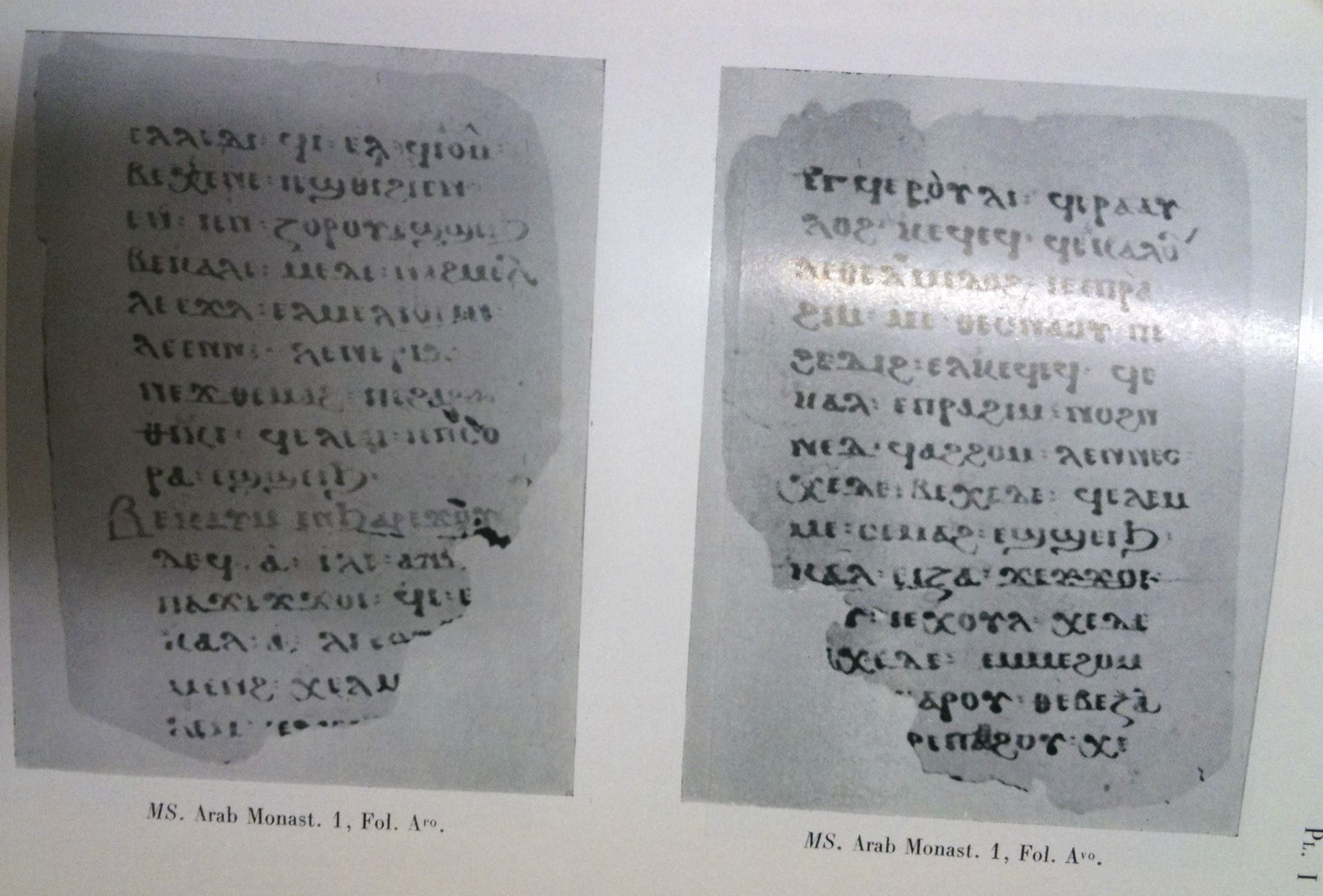
Figure 2:An Arabic-language manuscript in the Coptic script, the Sayings of the Desert Fathers, believed to be written in the 10th century CE.
From living sound to a dead language
Coptic, the last stage of Egyptian, was written in letters borrowed from Greek, and no one knows how those letters map onto real spoken vowels. We read the consonants with some confidence, relatively speaking. But there’s a second, stranger window: a medieval manuscript that writes Arabic (a living language) in Coptic letters. It’s a copy of the Sayings of the Desert Fathers, made when Coptic was fading but still read, by someone fluent enough in the script to spell another language with it. A living language we can still hear, written in the script we’re trying to decode. In miniature, it’s a Rosetta Stone for Coptic pronunciation.
The tempting way to read it is by eye: find a word, see which Coptic letter sits over which Arabic sound, declare a result. The whole point of the method is that this is exactly how you fool yourself. Choose your examples and you can “prove” almost any pronunciation you like. The evidence will oblige, and your own expectations will pick the examples for you. So the method refuses the eye. A program aligns the whole text, Coptic letter against Arabic letter, and measures how strongly each pair travels together (a correlation called the phi coefficient).
The dull results are the proof it works: the letters everyone already agrees on, ⟨ⲗ⟩, ⟨ⲙ⟩, ⟨ⲛ⟩ for l, m, n, come out firmly paired, as they must. The interesting results are the payoff, the cases where a letter behaves differently than the handbooks assume. ⟨ⲅ⟩, normally read g, lines up with [ɣ]. ⟨ⲃ⟩, normally b, lines up with [w]. And there’s a fresh possibility for the sound of ⟨ϫ⟩. The same machine that confirms the obvious is the one you then trust on the doubtful. That correlation table is drawn below as a colormap. The full method and results are written up in this paper.
The consonants are done. The vowels are the harder half, and where this morning’s tools come back. Measure the vowels of the recorded words with the formant code you already have, line them against the Coptic spellings, and reason toward sounds no one has heard in a thousand years. The notebook gives a first taste of that, one clean recording per vowel placed on the chart. The full multi-speaker version is the larger project.
The reasoning leans on assumptions, and the discipline is in stating them clearly: that the living language keeps the relevant distinctions, that the spelling is shallow enough to trust, that the scribe heard what we think he heard. None of it is certain, but all of it is more than we had before.
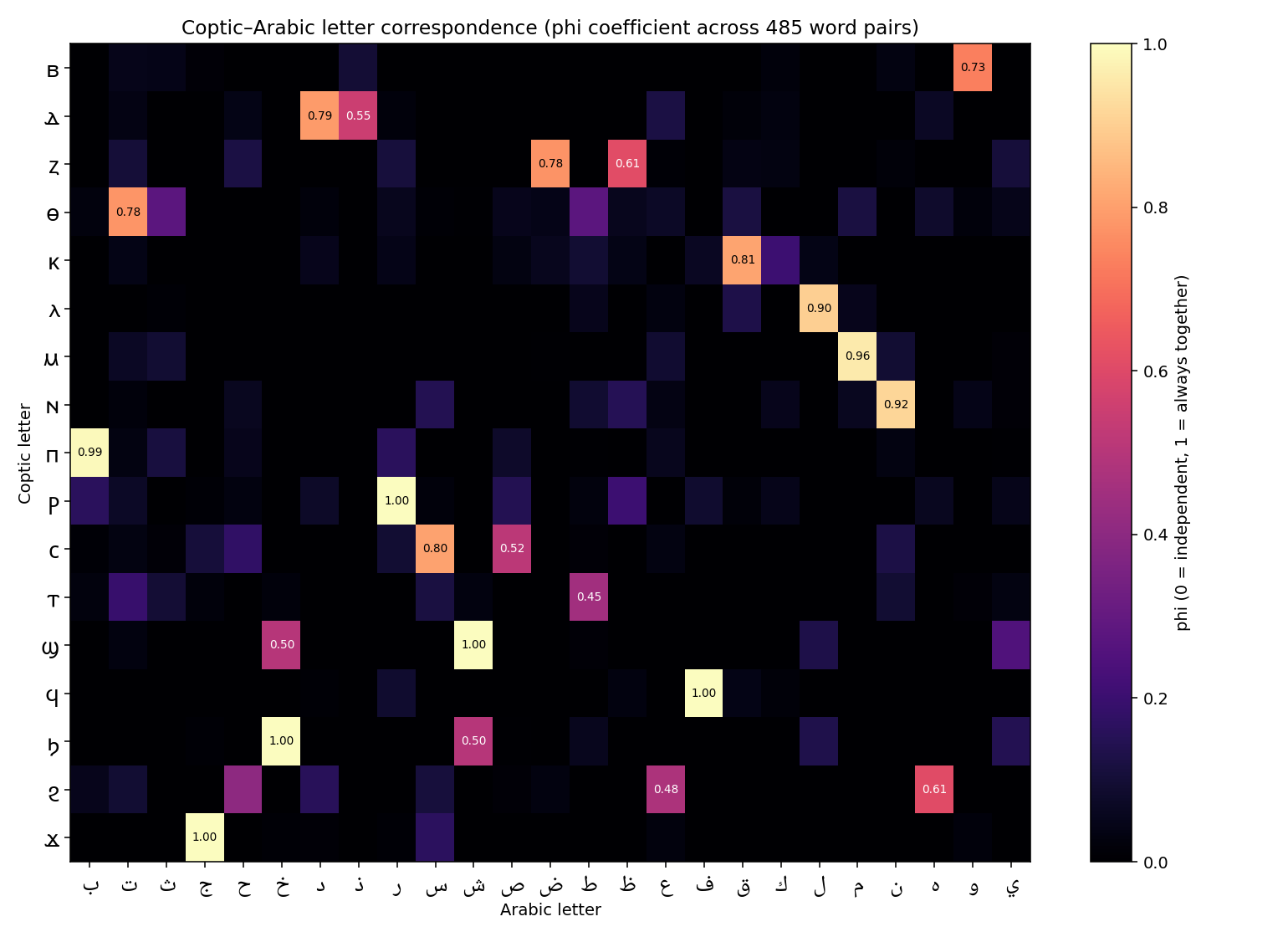
Figure 3:The full correspondence table: one cell per Coptic letter against each Arabic letter, measured as the phi correlation across the 485 aligned word pairs (bright means the two almost always travel together). The bright near-diagonal is the proof the method works, the letters everyone already agrees on falling out on their own: ⲗ with l, ⲙ with m, ⲛ with n, ⲣ with r, ϣ with š, ϥ with f, ϫ with j. The bright off-diagonal cells are the payoff: ⲃ lines up with Arabic w, ⲡ with b (Arabic has no p), and ⲕ with the back consonant q. Computed from the parallel word list, with the full code at github
Discussion questions
The method won’t let a human look at the data until the very end. What does that buy you and what might it miss?
Reconstructing a dead language’s sounds from a living one rests on assumptions. Which one seems most dangerous to you?
Chaucer’s pronunciation and Coptic’s sounds are reached by different routes: rhyme and meter for one, a living language in a borrowed script for the other. What do the two approaches have in common?